
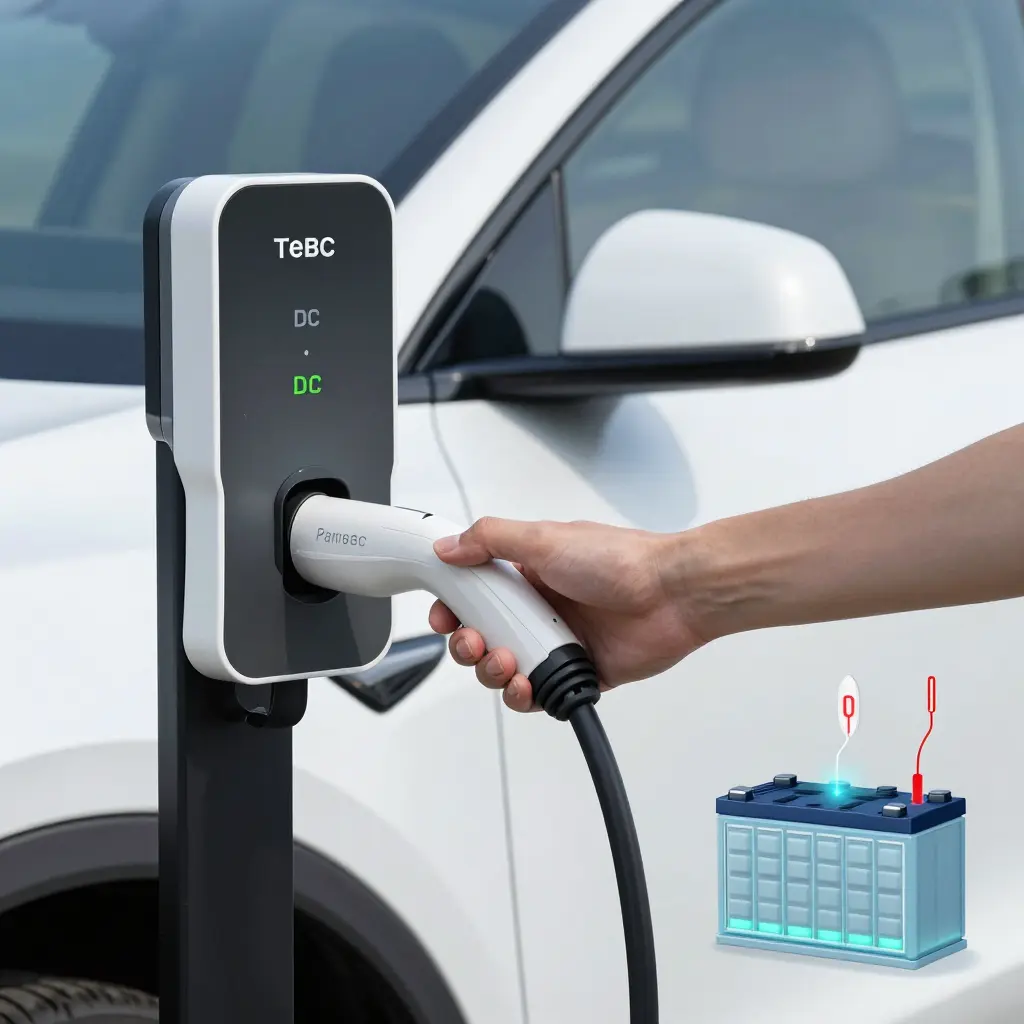
How DC Fast Charging Delivers Power
DC fast charging skips the slowest step. With AC charging, the vehicle’s onboard charger converts alternating current into direct current before any energy reaches the pack, and its output is capped by onboard hardware, which is most of the reason AC charging stays slow. A DC fast charger moves that conversion outside the car and pushes a high charge current straight into the pack, so the modest internal converter is never in the way.
Charger and pack work as a pair. Before power flows, the charger and the battery management system (BMS) complete a digital handshake over the connector’s communication pins. The BMS reports the pack’s voltage, state of charge, and the charge current it is willing to accept; the charger agrees on a target and starts ramping up.
The conversation does not stop once current is flowing. Every few hundred milliseconds, sensors feed cell voltage and temperature back to the BMS, which recalculates the safe charge current and tells the charger to adjust on the fly. Throttling is what that loop looks like from the driver’s seat: the system holding the cells back from heat and lithium plating, not failing.
Engineers and owners who want to watch the loop work can log it. Diagnostic and service software such as Mercedes Xentry software and Star software records charging-related battery data such as charge current, voltage, and temperature trends, which turns a single session into a usable dataset.
The Charging Curve and the Post-80% Taper
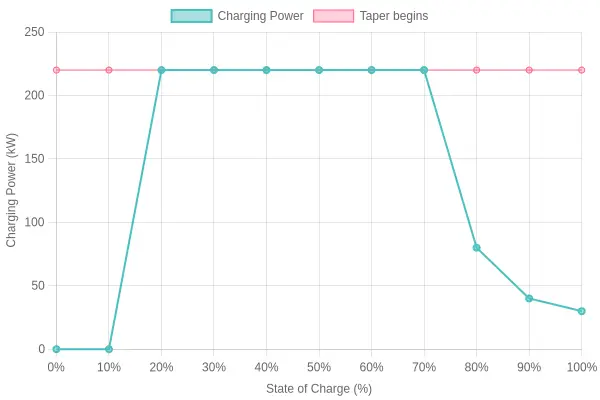
The charging curve is the shape of DC fast charging power as the battery fills, and it is rarely a flat line. Your EV does not hold maximum power from 0 to 100 percent: power rises, holds for a while, then drops. That drop is the taper, and it gets steep somewhere past 80 percent state of charge. Below that mark, many cars sit near peak power for a long stretch; above it, power falls fast, and the final few percent can take as long as the first half.
CC-CV in Plain Language
A charge session runs in two stages. In the constant-current (CC) phase, the charger pushes a steady, high current into the pack and power stays near peak. In the constant-voltage (CV) phase, the pack has reached its top voltage, so the charger holds voltage steady and lets current fall. That fall is the taper.
- High-power phase (below 80 percent): high current, near-peak power, fast state of charge gain.
- Taper phase (after 80 percent): falling current, dropping power, slow state of charge gain.
The taper is protection, not a defect. Forcing full power into a nearly full pack stresses the cells and adds heat, so the BMS pulls power back on purpose.
Two limits decide where the curve bends. Cell temperature climbs during the CC phase, and a hot pack can taper early. The C rate limit tightens as state of charge rises, because a fuller cell cannot absorb current as quickly. On a Mercedes-EQ model, those limits can shift after a Mercedes EQS software update.
DC Fast Charging Power vs State of Charge
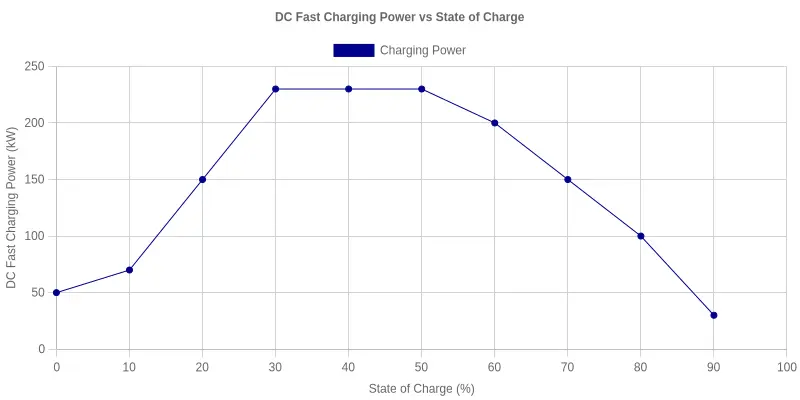
The sharp drop in charging power after 80 percent SOC reflects cell temperature rise and reduced allowable C rate limits.
Through the low-to-mid state of charge range, a battery will accept a high, flat charging power: the cells are still cool and the BMS can safely ask for a high C rate. Past roughly 80 percent SOC, the taper takes over and power falls steeply. The charger has not run out of capability — the cells are warmer and the acceptable charge rate has to shrink to protect them.
That falling tail is why a DC fast charge session always feels quick at the start and slow at the end. On Mercedes platforms, the software governing the taper curve matters as much as the hardware, and keeping those systems current is part of routine upkeep. Routine firmware management, including Mercedes-Benz software upgrade practices, is where that upkeep happens.
Cell Temperature Limits
Cell temperature ultimately decides how much current a DC fast charger is allowed to deliver. A charger’s advertised kilowatt rating describes its ceiling under ideal conditions; the BMS treats every session as a negotiation between available power and the physical condition of the cells. Charge rate and cell temperature cannot be separated.
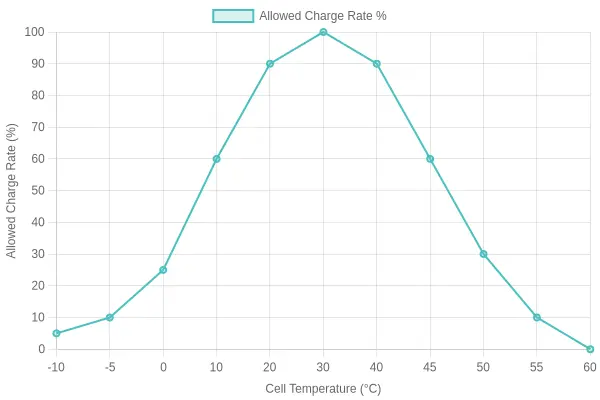
How Fast Charging Generates Internal Heat
Charging drives current through a cell’s internal resistance, and resistance turns electrical energy into heat. The relationship is not linear: heat generation rises with the square of the current (I-squared-R), so doubling the charge rate roughly quadruples the heat. At high C rates, that Joule heating can outrun what the pack’s thermal management (liquid-cooled cold plates, coolant loops, and heat exchangers) can remove. Without active cooling, cell temperature would climb by the minute.
The Optimal Operating Window
Most lithium-ion packs perform best between roughly 15 degrees Celsius and 35 degrees Celsius. Ionic conductivity is high and internal resistance is low in that band, so the BMS allows the maximum charge rate. As cell temperature approaches about 45 degrees Celsius, the system begins tapering current to keep the cells within safe limits. Near 50 to 60 degrees Celsius, charge rate is sharply reduced or charging is suspended entirely.
Why Cold Cells Also Reduce Charge Rate
Cold cells present the opposite problem. Low temperatures raise internal resistance and slow the reactions that accept lithium, and charging a cold cell too aggressively can cause lithium plating on the anode, which costs capacity permanently. The BMS therefore caps the charge rate well below normal, or blocks charging until the pack warms.
Protection by Design, Not Defect
Throttling is deliberate engineering, not a fault. The same protective logic that limits current at high temperatures sits in the charging management software governing models such as the Mercedes EQS software, where thermal limits apply to every session. When your vehicle slows down after 80 percent or in freezing weather, it is choosing battery longevity over charging speed.
What the C Rate Actually Means
The “C rate” describes charge or discharge current relative to a battery’s total capacity. If a pack stores 100 kWh, a 1C charge current delivers 100 kW, a 2C current doubles that, and a 3C current triples it.
High C rates are never free. Forcing current in faster raises internal resistance losses, and those losses show up as heat, which ages the anode and cathode and can trigger lithium plating.
State of charge (SOC) sets the ceiling. As SOC climbs, cells tolerate progressively lower C rates, and above roughly 80 percent the safe ceiling drops sharply, so a well-tuned BMS steps the effective C rate down to stay within temperature and voltage limits. That step-down is why DC fast charging throttles near the top of the pack.
Cell chemistry and pack design set the ceilings in the first place. Some chemistries accept high charge current far more gracefully than others, while the cooling loops, cell spacing, and busbar layout decide how much heat can be pulled away. Cold or hot ambient conditions shift the limits again, tightening the safe window whenever temperature drifts out of the sweet spot, which is usually why charging curves differ between models. Engineers tracking that behavior often monitor it through the Mercedes-EQ software used across electrified models.
Temperature Thresholds vs C Rate Limits: Side-by-Side
The table below maps how each throttle factor behaves on its own, so you can see where the limits collide once the pack crosses 80 percent. For a real-world example of how these limits are tuned in a Mercedes EV, see how the Mercedes EQS charging software manages its pack.
| Factor | What It Measures | Typical Safe Range | What Happens When Exceeded | How the BMS Responds |
|---|---|---|---|---|
| Cell Temperature | Heat buildup inside each cell during charging | ~20-40 C (68-104 F) | Above ~45 C: accelerated cell aging and side reactions | Tapers current, ramps up cooling, caps the allowed charge rate |
| C Rate | Charge speed relative to pack capacity (1C = full pack in 1 hour) | 0.5-2C for DC fast charging | High C plus high heat accelerates cell aging | Steps current down to a lower C ceiling |
| State of Charge (SOC) | How full the pack is | 10-80% for full-speed DCFC | Above 80%: voltage climbs, internal resistance bites | Rolls current off progressively toward the top |
| Internal Resistance | Electrical friction inside each cell | Rises with age, cold, and low SOC | Higher resistance means more heat per amp delivered | Reduces current to keep heat generation in check |
| Pack Voltage | Combined terminal voltage across the pack | Within the manufacturer cell-voltage window | Near max voltage, cells resist accepting more charge | Lowers current as voltage approaches the ceiling |
Caption: Cell temperature and C rate limits do not act alone, they work together to produce the characteristic post-80% throttle.
None of these factors pulls the trigger by itself. The BMS watches all five at once and throttles based on whichever one is closest to its limit, which is why two cars with the same battery can charge at very different speeds on the same day.
Why Lithium Plating Makes 80% a Turning Point
A lithium-ion cell is happiest when lithium ions slide between the layers of graphite in the anode, a process called intercalation. It works well, but it is not instant, and the graphite has only a finite number of spaces for those ions.
Past roughly 80 percent SOC, most of those spaces are taken. Force a high charge current into a nearly full anode and the incoming ions have nowhere to intercalate. They deposit as metallic lithium on the anode surface instead. That is lithium plating. The plated metal permanently steals usable capacity and can grow into sharp dendrites that puncture the separator and trigger internal short circuits.
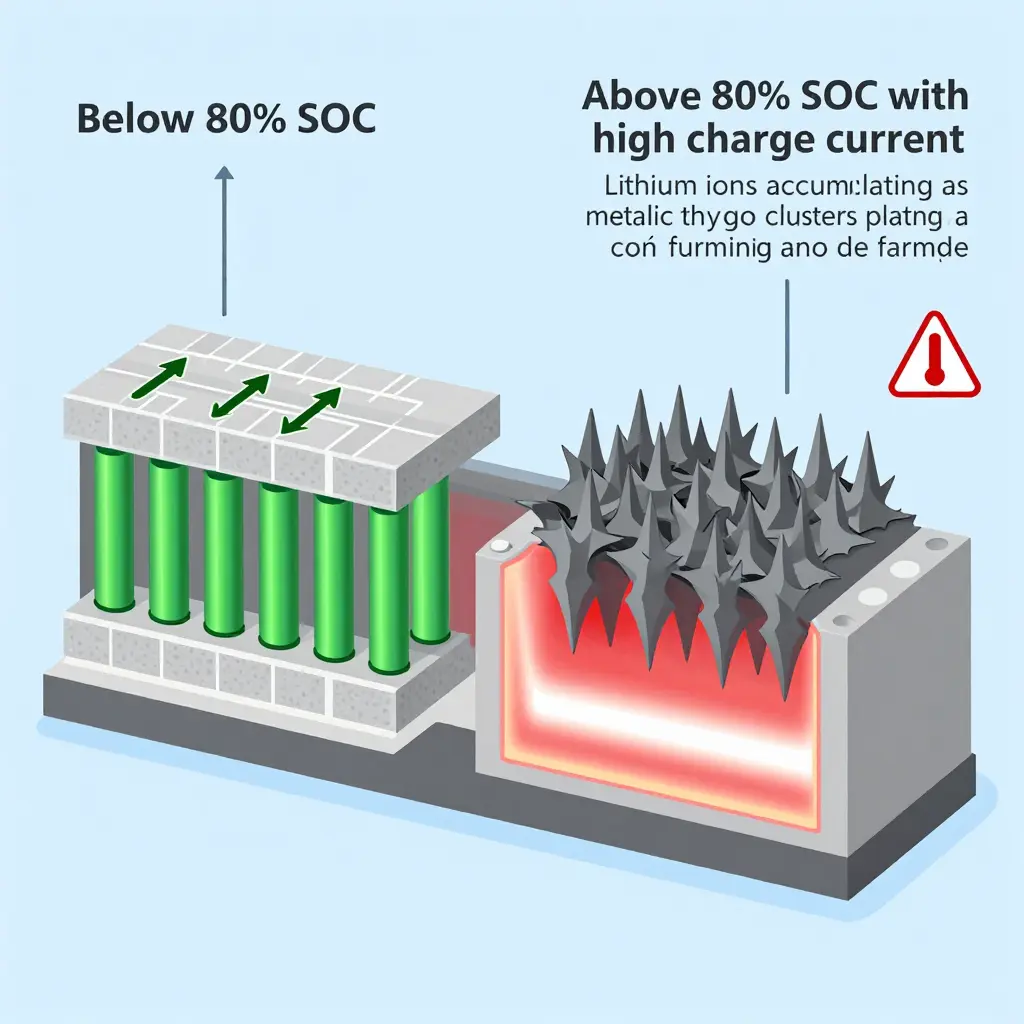
Two conditions make plating far more likely, and both get worse near the top of the pack:
- Cold cells. Low temperature slows the reactions that accept lithium, so ions arrive at the anode faster than they can be absorbed.
- Excessive C rate. A high current floods the anode with more ions per second than it can take in.
Heat plays a different role. Elevated cell temperature accelerates parasitic side reactions and ages the anode and electrolyte, which is why the BMS tightens its current ceiling as the pack warms even though plating itself is mainly a cold-and-fast problem. The battery degradation that repeated plating causes is cumulative and largely irreversible, so one aggressive session can quietly cost range for years.
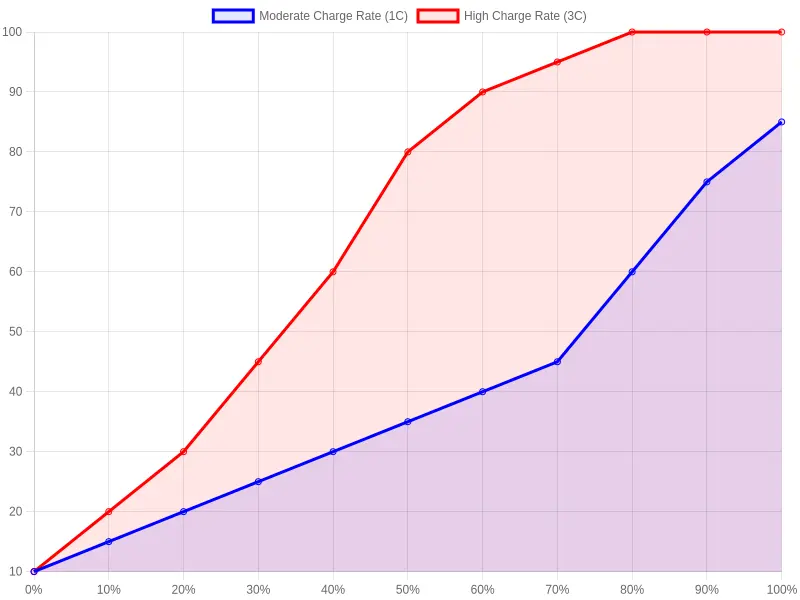
The DC fast-charging throttle is therefore protective, not punitive. By tapering charge current above 80 percent SOC, the battery management system, the same logic calibrated through regular Mercedes EQS software updates, keeps ions intercalating rather than plating. It trades a few extra minutes at the charger for years of healthy pack life.
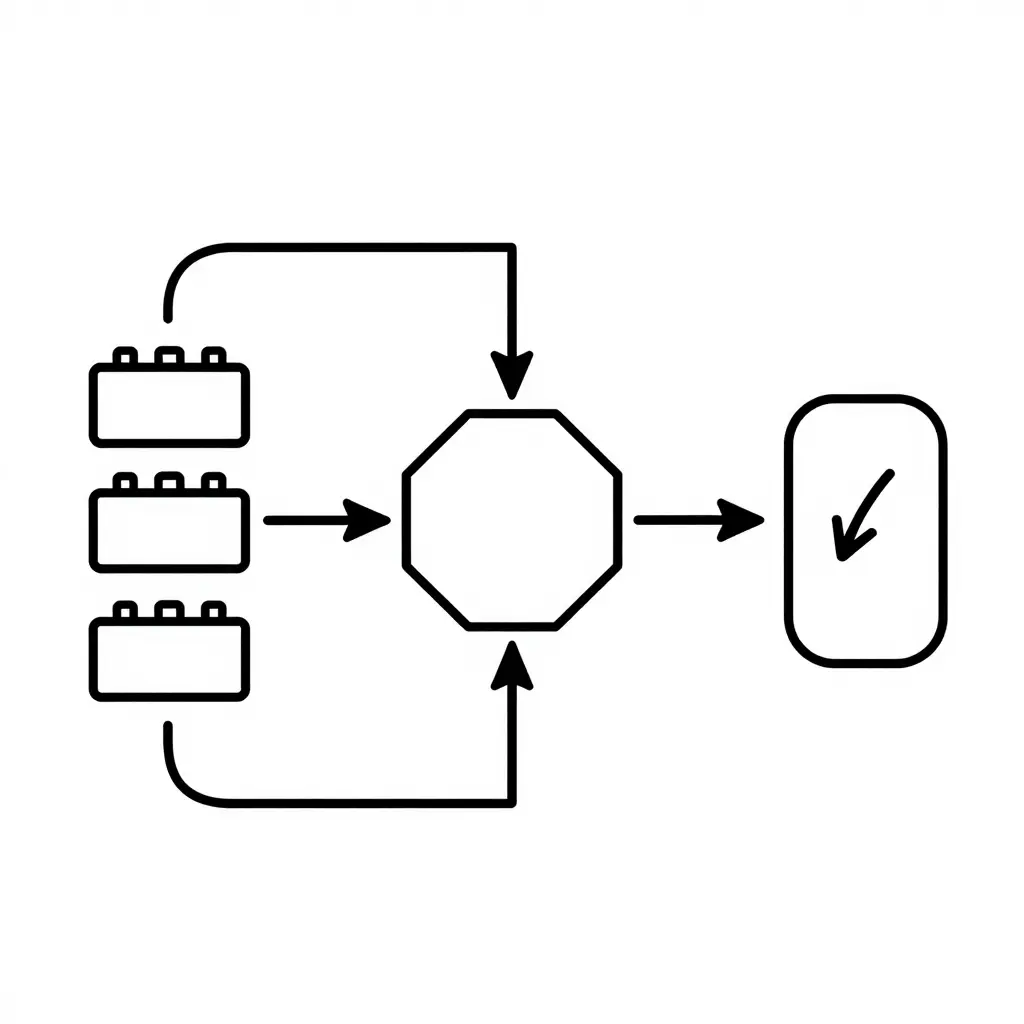
Caption: In this closed feedback loop, the battery management system continuously reads cell temperature, state of charge, voltage, and current, then trims the requested charge current sent back to the charger, which is exactly how fast-charge throttling above 80 percent gets enforced. For owners of Mercedes EVs running this logic in software, see Mercedes EQS software for the underlying modules that govern charging behavior.
The Role of the BMS in Throttling
The battery management system (BMS) is the referee of every DC fast-charging session. It samples each module continuously, tracking cell temperature and the effective C rate at which energy flows into the pack. Those two variables rarely move in step, so the BMS fuses them into a single safe current request: the maximum charge current the vehicle will accept at that instant.
As limits are approached, the BMS stops treating the charger as an on/off tap and commands it to reduce power smoothly. A warm cell or a rising C rate produces a gentle taper rather than an abrupt cutoff, which keeps the pack away from lithium plating and preserves long-term capacity.
That is why two identical cars can show different taper points on the same charger. Temperature history from earlier driving, ambient conditions, and the exact charge state all differ, so each BMS effectively writes its own taper curve.
Engineers inspecting those decisions rely on diagnostic data logging. Platforms such as Mercedes Star Finder software and dedicated engine diagnostic software let technicians read BMS-reported limits in real time and confirm whether a taper comes from cell temperature, C rate, or the vehicle’s programmed charge current ceiling.
Implications for EV Owners, Engineers, and Charging Infrastructure Developers
For EV Owners: Realistic Expectations Past 80 Percent
If you have watched your car crawl from 80 to 100 percent, you have seen the taper up close. On a DC fast charging stop, rising cell temperature and a higher state of charge push the battery management system to lower the allowed C rate, protecting the cells from lithium plating and excess heat. Expect the last 20 percent to take as long, or longer, than the first 80. Many modern EVs finish a 10-to-80 percent sprint in roughly 18-30 minutes, then need another 30-50 to reach full. For daily driving, stopping near 80 percent is quicker and gentler on the pack.
For Automotive Engineers: Designing the Taper
How hard an EV tapers is a design decision, not a fixed rule. Pack design sets the ceiling, because cell chemistry, module layout, and the usable buffer above 80 percent determine how much current the pack can accept. Thermal management decides how long it can hold that current, since sustained heat forces earlier protection. Software calibration then draws the actual curve, balancing speed against longevity using live cell temperature, voltage, and C rate data. Those calibrations keep changing, so recurring battery and charge-management software updates matter for long-term performance.
For Charging Infrastructure Developers: Planning Around the Curve
Taper behavior shapes how charging infrastructure should be planned. Vehicles draw far less power at high state of charge, so a 350 kW dispenser rarely delivers 350 kW across a full session. Smart power allocation, dynamic sharing between stalls, and realistic utilization models all depend on knowing each vehicle’s taper. Operators who plan around average delivered power rather than peak ratings build stations that serve more cars, cut congestion, and keep drivers moving.
FAQ: DC Fast Charging and the 80 Percent Throttle
Why does charging slow specifically after 80 percent?
Past 80 percent state of charge, internal resistance climbs and the usable voltage window narrows, so the BMS deliberately reduces current to prevent overvoltage and lithium plating. That controlled slowdown is the taper, and it is why DC fast charging delivers its highest power in the empty-to-mid range. Most manufacturers design the ideal road-trip window around 10 to 80 percent.
Is the throttle caused by cell temperature or C rate limits?
Both limits act together, but which one binds first depends on the situation. The BMS watches cell temperature to keep the pack inside a safe thermal band while capping the C rate, the charge current relative to capacity. In a warm pack, the C rate limit usually dominates; a cold pack hits its lower temperature limit first.
Can I force a faster charge past 80 percent?
There is no safe, manufacturer-approved way to override the taper. The controller enforces current limits to protect the cells, and defeating them invites accelerated degradation or a thermal event. Some cars let you adjust charge targets or precondition the pack, but none allow you to ignore the protection envelope. Owners monitoring a Mercedes EQS software interface can watch these limits, but they cannot bypass them.
Does throttling happen in cold weather too?
Yes, and cold weather often makes it worse. Below roughly 10 degrees Celsius, the BMS restricts DC fast charging until the cells warm up, because charging a cold pack risks lithium plating. Battery preconditioning, which heats the pack before arrival, is the best way to recover speed in winter.
Does frequent fast charging permanently damage the battery?
Occasional DC fast charging has little lasting effect, and modern packs are built for it. But frequent high-rate sessions that also raise cell temperature accelerate capacity fade over thousands of cycles. Charging at home on AC for daily top-ups and saving fast charging for trips keeps degradation modest.
Does every EV taper at the same SOC?
No. Taper behavior varies widely with chemistry, pack size, and thermal design. Some models begin reducing power well before 80 percent; others hold high rates a little longer. The 80 percent figure is a familiar industry benchmark, not a universal cutoff.
Conclusion: Throttling Is Protection, Not a Problem
Why does power suddenly taper once the battery passes 80 percent? Not because of a glitch. Two physical limits are working together. As cell temperature climbs during a heavy DC fast charging session, and the pack’s acceptable C rate shrinks in the high state-of-charge window, the charge-management system deliberately throttles current to keep both limits in check and to keep the anode clear of lithium plating, where metallic lithium deposits and permanently erodes capacity. The taper after 80 percent is the battery declining more energy because accepting it would cause damage.
- The post-80 percent taper is intentional engineering, not a fault: the BMS protecting the pack from lithium plating and excess heat.
- Two forces drive the slowdown: rising cell temperature and a falling safe C rate as the battery fills, both of which tighten the acceptable charging window.
- Slower power in the final 20 percent buys a longer-lasting, safer battery, even if the last stretch of a DC fast charging stop feels sluggish.
- Diagnostic and maintenance software keeps battery and charge-management systems current, so staying on top of updates, including a proper Mercedes software upgrade, helps the charging strategy stay optimised over the vehicle’s life.
The Bottom Line: A Healthy Battery Knows When to Slow Down
That curtailment is a feature, not a flaw. Understanding how cell temperature and C rate interact turns an annoyance into reassurance, and it explains why engineers settled on the 80 percent threshold in the first place.