

Mercedes-Benz Software Engineer Interview Questions: Tracing Xentry Fault Codes and ECU Flash Recovery
Mercedes-Benz software engineer interview questions rarely stop at textbook definitions. Interviewers hand you a live diagnostic scenario and watch how you reason through it, because one misread log entry can send a repair down the wrong path for hours.
Two tasks come up again and again: tracing Xentry fault codes, and recovering an ECU when a programming session dies halfway through. Both test tooling knowledge, patience, and whether you can troubleshoot in order instead of guessing.
Tracing a fault code means following the DTC back to the physical or logical cause instead of swapping parts on a hunch. Flash recovery means getting a control unit running again after an interrupted or corrupted write. Neither is about memorizing menus; both come down to whether you understand what the software is actually talking to.
How Xentry Fits Into Modern Mercedes-Benz Diagnostics
Xentry is Mercedes-Benz’s own diagnostic platform, the factory toolset used to talk to every control unit in a modern car. When a module stores a fault, Xentry reads that memory and decodes it into an Xentry fault code tied to a specific component, symptom, and repair path.
Interviewers usually ask how the pieces fit together: XENTRY Diagnostics, XENTRY Pass Thru, and the rolling data updates. Knowing where each one sits shows you understand both the workshop workflow and the software pipeline underneath it. For background, see Mercedes-Benz diagnostic software and the deeper engine diagnostics material.
Core Xentry capabilities include:
- Guided fault finding with step-by-step test plans
- Live data streaming from control units in real time
- Actuator testing to command and verify hardware
- Variant coding and control-unit adaptation
- Flash programming and ECU software recovery
A current XENTRY diagnostic subscription keeps fault definitions and flash files in step with new control units.
Each fault-code family gets triggered differently, and interviewers expect you to explain the reasoning each one calls for. The table below is a quick reference.
Xentry Fault Code Categories and What Candidates Must Explain
| Fault Category | Typical Code Range | Common Trigger | Interview Focus | Related Resource |
|---|---|---|---|---|
| Powertrain codes (P-codes) | P0000-P2999 | Fuel trim drift, misfire, sensor correlation | Separate root cause from symptom; read freeze-frame data | Engine diagnostic software |
| Body/comfort codes (B-codes) | B0000-B2999 | Door modules, seats, HVAC, locking logic faults | Group codes logically by control unit before probing | Sprinter diagnostic software |
| Communication/CAN bus codes (U-codes) | U0000-U2999 | Bus-off events, wiring faults, module dropouts | Reason through network topology and termination resistance | Xentry software |
| Pending vs. stored codes | Status flag on any family | Intermittent vs. confirmed fault states | Explain drive-cycle logic and when a code promotes to stored | OBD2 software download |
| Event/status codes | Varies by subsystem | Voltage dips, coding changes, adaptation resets | Read surrounding context, not the code number alone | Star software guide |
| Network/protocol codes (UDS-related) | Model-specific | Handshake timeouts, session errors during flash | Tie protocol errors to ECU flash recovery steps | Software engineer interview questions |
Tracing Fault Codes Like an Interview-Ready Engineer
Fault-code tracing follows a sequence, and interviewers want to hear you narrate it. Start by reproducing the condition: pin down the trigger, temperature, and load so the fault stops being random. Then read and clear fault memory, and read it again to see which codes come back. Codes that return are active; codes that stay gone are history.
Freeze-frame data is the next stop, because it holds the parameters logged at the moment of failure and points at the cause rather than a downstream symptom. From there, check wiring and sensor signals with a multimeter and oscilloscope, confirming voltage, ground, and continuity before you replace anything. When the repair is done, clear the codes and repeat the original reproduction steps. If the fault doesn’t come back, it’s gone.
The sequence is reproduce, log, interpret, verify, confirm. Each step removes a possibility, which is what interviewers are listening for: a method, not a guess. Sharpen it through guided fault finding.
Flash recovery is easier to explain as a pipeline, with one job at each stage: catch the failure, remove whatever caused it, get the module writable again, push clean firmware, confirm the result in Xentry, and reset the learned values left over from the corrupted session. The diagram below lays out that flow end to end.
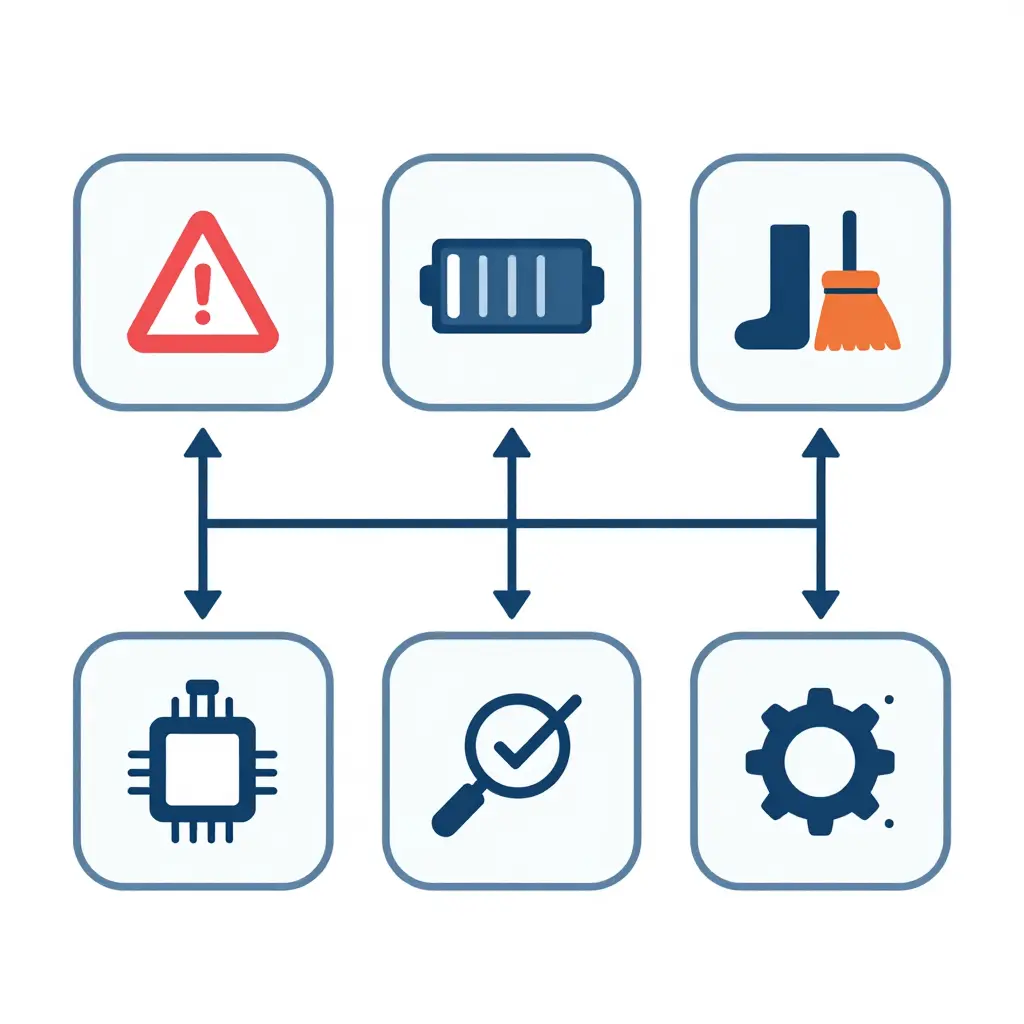
Read it left to right, and treat every arrow as a gate you cannot skip. Flash over an unstable supply, or over a module still stuck outside boot mode, and a recoverable brick turns into a replacement unit.
ECU Flash Recovery: What Interviewers Want You to Explain
This topic separates candidates who memorized a procedure from those who have actually pulled a bricked module back. Start by naming the failure modes: voltage dropping below threshold, a data transfer interrupted mid-block, or a software version mismatch that fails the handshake. Any of them can leave a control unit silent and unresponsive.
Voltage is where most of this is won or lost. Across any Mercedes-Benz software update, hold at least 13.5 volts with a supported battery charger rather than leaning on the vehicle battery. If the flash still dies, boot-mode recovery reaches the ECU directly so you can push a clean firmware re-flash through the bootloader.
- Maintain 13.5V+ across the entire write cycle
- Use a supported battery charger, not a jump pack
- Verify data versions match the VIN and variant
- Save the original configuration before flashing
Then explain the rollback: save the original configuration, retry the Mercedes-Benz software upgrade, and confirm the result with Xentry post-flash verification. If you can walk through upgrade Mercedes software workflows from memory, this question is straightforward.
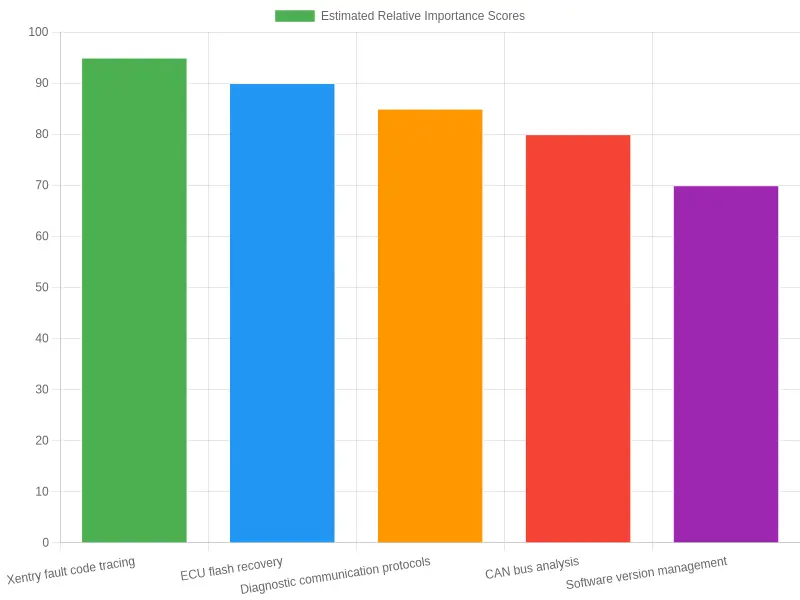
The chart below shows where employers place the heaviest weight across diagnostic skills for these roles.
Common Interview Questions and Model Answers
These questions test how you reason under pressure while tracing Xentry fault codes and handling flash recovery. The panel is listening for diagnostic logic, not tool trivia. Six frequent questions and short model answers follow.
-
How do you tell a stored code from a pending code? A pending code sets within the current or last drive cycle and is not yet confirmed, while a stored code matures after two consecutive failing cycles. I always read the status byte in Xentry rather than trusting the code text alone.
-
How do you diagnose an intermittent CAN fault? I review freeze-frame data and event counters, then wiggle-test connectors while logging live bus traffic. Resistance and oscilloscope checks confirm whether the root cause is wiring or a failing module.
-
How do you recover an ECU after a failed flash? I reconnect, force the control unit into boot mode, and re-flash with a stabilized supply above 13 V. For deeper background on these procedures, see this guide to Mercedes-Benz software engineer interview questions.
-
How do you validate a software update version? I compare the part number and software version in the control unit against the release notes, then run a short functional test. I also follow the latest Mercedes-Benz software update news to confirm the expected build.
-
How do you handle a fault that does not reproduce? I document the exact conditions, review historical DTCs, and escalate to long-term data logging before closing the ticket.
-
How do you prioritize DTCs? I rank by safety impact first, then drivability, then comfort, and always resolve root-cause codes before their consequential ones.
Across all six, the same pattern shows up: safety first, then root cause.
Edge Cases That Separate Strong Candidates
The gap between candidates shows up on failures that don’t fit the manual.
When communication drops mid-flash, don’t just hit retry. Read the Xentry fault codes and pick a controlled ECU flash recovery path.
If variant coding is corrupted, restore the correct dataset before flashing, and check the hardware and software part numbers first.
For a module replacement that needs SCN coding, confirm VIN and serial data before writing anything.
A VIN mismatch after an ECU swap has to be checked against the central gateway, not assumed away. The Mercedes-Benz Star software download procedures cover these checks; follow them and document every action so the decision trail stays auditable.
Every one of these is graded on judgment under uncertainty. Interviewers watch whether safety comes before speed.
Frequently Asked Questions
What is the difference between Xentry and STAR Diagnosis?
Xentry is the current Mercedes-Benz diagnostic platform, while STAR Diagnosis (DAS) is the legacy system it replaced. Xentry adds guided diagnostics, live data, and clearer Xentry fault codes, whereas STAR Diagnosis relied on older interfaces and manual fault interpretation.
How often are Xentry data updates released?
Mercedes-Benz usually releases Xentry diagnostic data monthly or quarterly, with larger releases a few times a year. Keeping current keeps your Xentry fault codes and ECU flash recovery procedures aligned with the newest control units, so confirm the version before a job.
Can an independent workshop legally access a XENTRY diagnostic subscription?
Yes. Independent workshops can obtain a legitimate XENTRY diagnostic subscription through authorized resellers, with no dealer affiliation required. This grants access to genuine diagnostic and programming features for supported Mercedes-Benz vehicles.
What causes an ECU flash to fail and how is it recovered?
ECU flash failures usually stem from voltage drops, interrupted data links, or mismatched firmware files. ECU flash recovery starts with a stable power supply, then a clean re-flash using the correct software build.
How should I prepare for Mercedes-Benz software engineer interview questions?
Focus on diagnostic workflows and practice explaining how you trace faults end to end. Reviewing Mercedes-Benz software engineer interview questions helps you connect fault-code theory with real repair scenarios.
Preparing With the Right Tools and Mindset
These interviews reward two things: structured reasoning and real time on genuine diagnostic software. Explaining your logic calmly while tracing Xentry fault codes says more than any rehearsed answer, and the same goes for ECU flash recovery, where the work is slow and unforgiving.
Time-based XENTRY diagnostic subscriptions let independent workshops and candidates practice on real vehicles without a long-term contract. For those refining their responses to Mercedes-Benz software engineer interview questions, that practice is what makes an answer sound like experience rather than recall.